
Funerals have a way of rearranging your sense of time, don’t they?
They pull people from different chapters of your life into the same room and ask you to sit with it – sit with who you were, who you have become, and who was there…and who wasn’t, along the way.
I went to a funeral recently for someone I worked with years ago – someone who reported to me early in my career. After the service, a small group of us who hadn’t seen each other in nearly eight years went to lunch.
Different companies now. Different lives. Different seasons.
And yet.
Within minutes, we were laughing like no time had passed. Not polite catching up. Not surface-level updates. Real laughter. Shared shorthand. Stories that didn’t need context. We slipped back into rhythm as if we’d just left the office yesterday, instead of nearly a decade ago.
At some point, somewhere between stories and half-finished sentences, it hit me how natural it all felt. How little effort it took to be there with them.
And that’s when I said something out loud, I hadn’t realized I’d been carrying:
“I’ve been with my current company for almost eight years – and there’s no one there I could do this with.”
Let me pause for a moment and make this clear: I like my current colleagues. I have friends at work. We laugh. We joke. We’re friendly and supportive. We do good work together.
But eight years from now? If I ran into current teammates at a funeral and went to lunch afterward, it wouldn’t feel like this. We wouldn’t pick up mid-sentence. We wouldn’t fall back into the same easy knowing.
Anyway, back to my too honest comment. The second it left my mouth I froze. What had I just said, and more importantly, why? I immediately expected it to land awkwardly. To sound ungrateful. Or worse – nostalgic in a way that our heavy hearts weren’t ready to hold.
I watched as the table went quiet.
Surprisingly, not uncomfortable. Just still.
Then someone nodded. And then another.
Not because they agreed with the words exactly, but because they recognized the feeling underneath them.
We sat with that for a minute – letting it settle – before we started trying to understand it. Not to explain it away, but to make sense of why the relationships had endured. Why they still lived so vividly in our hearts all these years later.
Here’s what we came up with.
First, we were all becoming…together.
We weren’t kids, exactly. But we were early enough in our careers – and our lives – that nothing felt settled yet. Titles were still tentative. Confidence was still borrowed. We were trying on versions of ourselves in real time, sometimes discovering what fit and sometimes realizing, painfully, what didn’t.
We were learning how to lead without having language for it yet. How to fail publicly and still come back the next day. How to recover from mistakes without letting them calcify into shame. How to be ambitious without burning ourselves – or each other – to the ground.
We watched each other stumble and stretch. We saw the messy drafts before the polished LinkedIn bios. We knew who was bluffing, who was scared, who was quietly brilliant before anyone else noticed.
And because we were becoming, side by side – unevenly, imperfectly – there was a generosity baked into those relationships. We extended grace because we needed it ourselves. We remembered each other not as fixed professionals, but as evolving humans.
That kind of shared becoming does something powerful: it binds you not just to who someone is, but to who they were brave enough to become in front of you.
Second, and this isn’t cliché, we genuinely liked each other.
Not in the performative, professional way we often mean when we say that now. Not “we collaborate well” or “we enjoy working together.”
We liked each other as people.
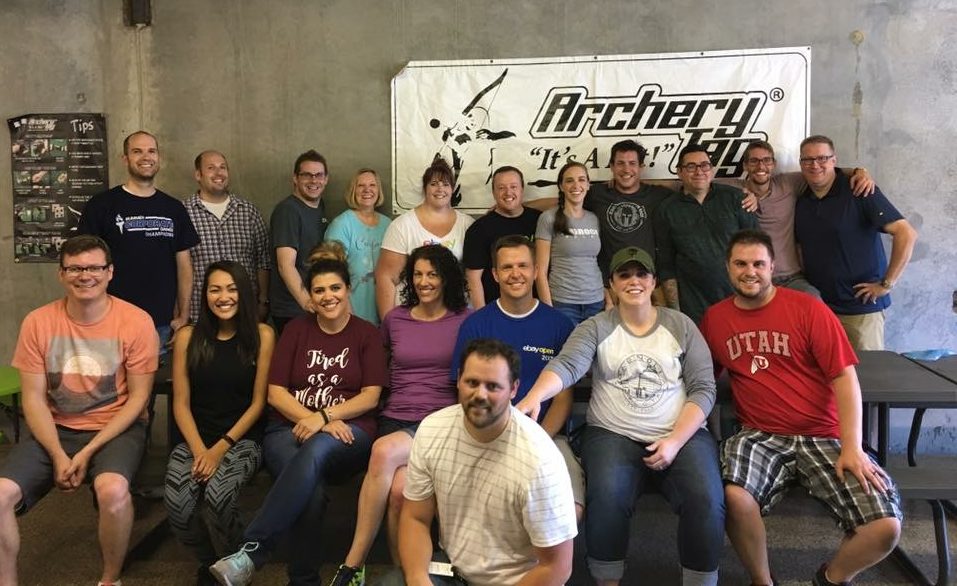
At the eBay office, there was a large table in the café that everyone in the building knew not to take. It belonged to the training team – anywhere from eight to twenty of us on a given day – and we sat there every single lunch.
Every single day.
No calendar invites. No agenda. No rotating attendance. Just a shared understanding that this was where we gathered. And over time, those lunches did what shared time always does – they blurred the lines between professional and personal in the healthiest way. We knew about each other’s kids and partners, yes, but also about the quiet things: who was struggling, who was hopeful, who needed a little extra grace that week.
We celebrated birthdays and holidays. We showed up for grief. We laughed – often and loudly. We disagreed and came back the next day anyway.
Spending time together wasn’t something we optimized for or justified. It was the default setting.
And, sitting around the table, eight years later, we all realized that’s the part that has simply been lost in today’s hybrid world.
Because liking each other requires unstructured time. It requires repetition. It requires seeing people on their good days and their ordinary ones – not just when they’re prepared, polished, and “on.”
You don’t get that from meetings alone. You get it from shared tables, shared routines, and the quiet permission to be human in front of one another.
Which led to the third realization – the one that landed the hardest.
It was pre-pandemic.
Not just before remote work, but before work itself was fundamentally rearchitected.
We were in the office every day. Not occasionally. Not “when it made sense.”
Every day.
We noticed absences. We picked up on mood shifts without needing status updates. We knew when someone wasn’t okay long before they found the words for it. Rituals formed not because they were designed, but because proximity makes them inevitable.
We made the office fun because it was where life happened, and we didn’t know any other way to endure the ordinary days.
Then the world changed – and with it, the rules of work.
Don’t get me wrong, remote and hybrid work gave us flexibility, access, and autonomy that matter deeply. For many people, they weren’t just improvements – they were necessary, even life-saving. That truth isn’t negotiable, and it shouldn’t be minimized.
But the trade was real.
Even in organizations that have returned to the office full-time, something hasn’t come back. The rhythm is different. The urgency to be together has softened. The default assumption is no longer shared presence, but individual choice.
Work has become heavier in some ways – and thinner in others.
We simply stopped growing up together.
Relationships became intentional instead of incidental. Efficient instead of immersive. Carefully maintained rather than unconsciously accumulated.
Belonging became something you opt into – and anything that requires opting in competes with everything else in our already full lives.
And because of that, over time, belonging becomes…well, rare.
Anyway… I don’t have a tidy conclusion or a call to action here. This isn’t a manifesto or a prescription for how work should be.
I think it’s just a realization.
Some of the most meaningful professional relationships of my life weren’t built through strategy decks or culture statements. They were built through shared lunches, daily presence, and the slow, almost invisible accumulation of ordinary moments – the kind that you don’t recognize as formative until the moment has long passed.
And realizing that we as a society, that my kids may never experience that kind of work friendship again – that stopped me in my tracks.
Not angry.
Not bitter.
Just… quietly sad.
Take this as the reflection of someone well into her career, looking back through a softer, more generous lens. Or maybe it’s a quiet wake-up – not about trying to recreate what was, but about being more intentional with what is still possible now.
Either way, it feels like something worth naming.
Because those moments mattered. Those people mattered. Deeply.
The ones who watched you become – not just the polished version you present to the world, but the messy, uncertain, still-figuring-it-out version too.
The ones who celebrated your wins and sat with you through your losses.
The ones who showed up in moments of grief and made space for laughter on the most ordinary days.
Those relationships shaped who I am – professionally and personally – in ways no role or title ever could. And they deserve to be acknowledged.
So maybe this isn’t about asking what work should look like next, or trying to solve for something that doesn’t have a clean answer.
Maybe it’s simply about pausing long enough to say, “thank you”. Thank you to the people who stood by us as we became who we are.

 Christine Marie
Leave a reply to Shaun Prinster Cancel reply